How Browzer Learn is helping universities 'flip the script' on student conduct
This case study is based on a session we presented at ASRA’s Southeast event on 3 December 2025, titled ‘From Discipline to Development’.
Moving from reactive punishment to proactive education – how CampusLife support operations teams to deliver engaging educational training on E6, drug and alcohol awareness, and behavioural issues within student accommodation.

The challenge
Operational strain for routine admin
Less mental capacity to focus on high-risk cases
Inconsistency in delivering student conduct
For accommodation operations teams, a significant amount of time is traditionally lost to managing low-level student behaviour.
Staff often find themselves stuck in a reactive loop of arranging and delivering repetitive training or one-to-one disciplinary meetings for routine infractions like noise complaints or kitchen misuse.
We call this the ‘Student Conduct Treadmill’.
The solution: Education over punishment
CampusLife introduced a fundamental shift in managing student behaviour, moving away from a punitive, staff-led model to an educational, student-led approach using Browzer Learn.
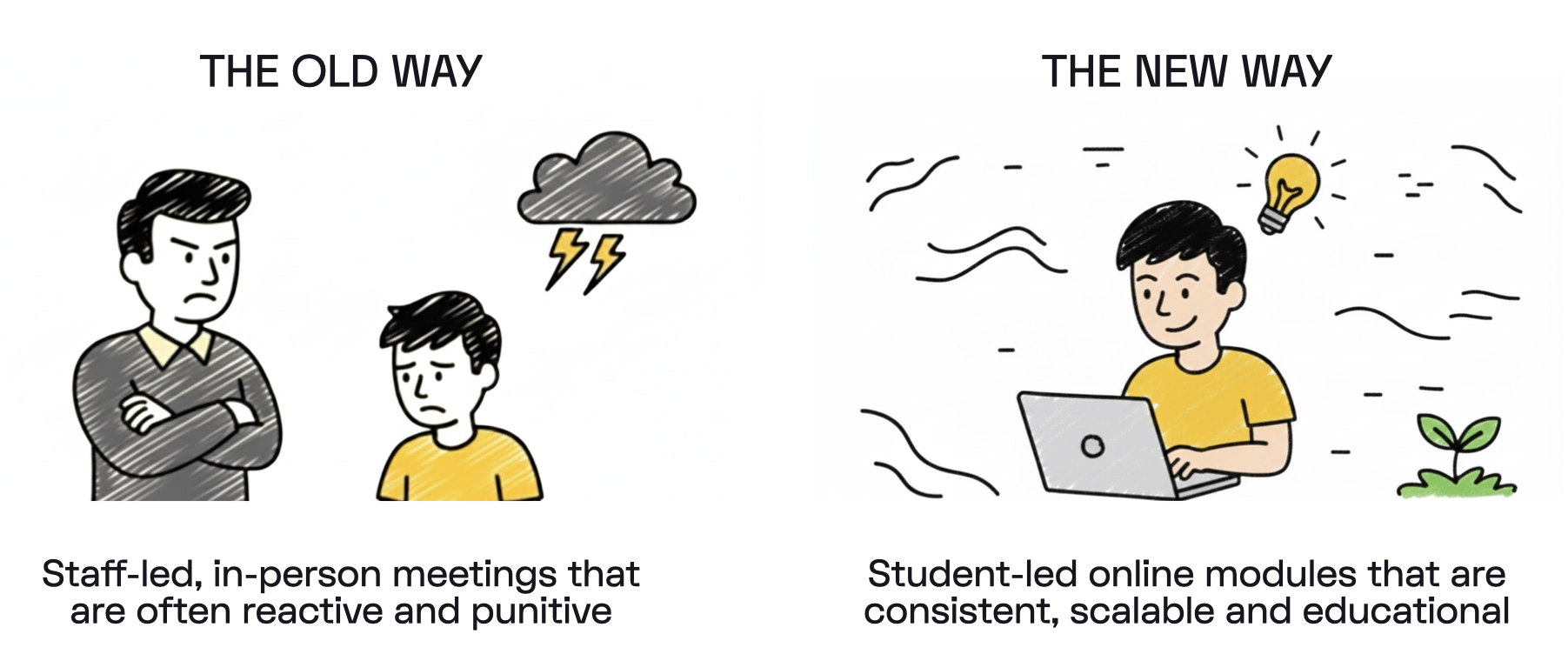
Browzer Learn combines a custom-built online training platform with CampusLife’s expert video content.
The platform allows students to complete structured learning modules on their mobile or desktop, offering a personalised journey that includes quizzes and reflective pieces to ensure genuine understanding.
By automating the response to essential training and low-level reactive issues, the platform frees up staff time and headspace, allowing them to focus on what really matters: supporting students.
So what does that look like in practice?
Fire safety training and education
The goal? Equip students with practical life skills regarding fire safety to reduce alarm activations and negligent behaviour.
This is comprised of a ‘Halls Disciplinary’ Browzer Learn platform, specific to fire safety regulations. The course utilises engaging video content that moves beyond a simple list of rules.
The result is a scalable system where students complete modules, quizzes, and reflective pieces, allowing staff to assess progress without scheduling in-person meetings for every minor breach.
Drug awareness and harm reduction
CampusLife are partnered with the University of Southampton and the charity, No Limits, to create accurate, peer-led video content around this sensitive and ever-evolving topic.
The modules feature real students discussing risk in a non-judgmental environment. Key concepts covered include:
The Risk Ladder: A workshop-style activity where students categorise behaviours (e.g. mixing alcohol and cocaine) by risk level.
Start Low, Go Slow: Practical advice for harm reduction.
Mixing is Risking: Educating students on the physiological dangers of combining substances, such as the creation of cocaethylene when mixing alcohol and cocaine.
“It has a massive educational benefit to anyone who is currently just issuing fines or warnings for discipline outcomes. Browzer Learn is engaging and easy to navigate, making it accessible for students to take something away on why they shouldn’t repeat what they did.”
OfS Condition E6 Compliance
As of 1 August 2025, the Office for Students has set out strict requirements for universities to meet around the topics of harassment and/or sexual misconduct.
Since 2024 CampusLife have been working in partnership with The University of Manchester to deliver effective engaging training to their students. This training is built in to the wider accommodation on-boarding content, which puts topics like consent alongside more practical information about living on campus.
This module uses the F.R.I.E.S. model to make the concept of consent memorable and actionable.
The feedback on this work has been phenomenal. The University and CampusLife were nominated for a CUBO award in Summer 2025 for this project, and students have commented how important it is to them.
“I enjoyed all parts of this module, especially the consent section because it was associated with F.R.I.E.S. which made things easier to understand. In my country, universities wouldn’t have approached the consent subject... I can’t wait to move there!”
By implementing Browzer Learn, accommodation teams are seeing benefits across three pillars:
Operational Efficiency: The automated platform removes the ‘treadmill’ effect, saving staff hours and reducing administrative burden.
Commercial Benefits: Better-educated students lead to fewer damaged items, less misuse of equipment and a reduction in maintenance call-outs.
Student Wellbeing: The platform creates a proactive feedback loop. Data on module engagement and specific disciplinary trends (e.g. noise complaints in a specific hall) allows teams to shape pre-arrival communications for the following year, helping to prevent issues before they event start.
“This frees up a huge amount of my time and headspace.”
Browzer Learn isn’t just a disciplinary tool, it’s an essential cog in your community-building strategies.
By treating students as adults capable of learning and reflection, universities can cultivate communities that are safer, more respectful and eventually self-regulating.
Ready to transform student engagement?